


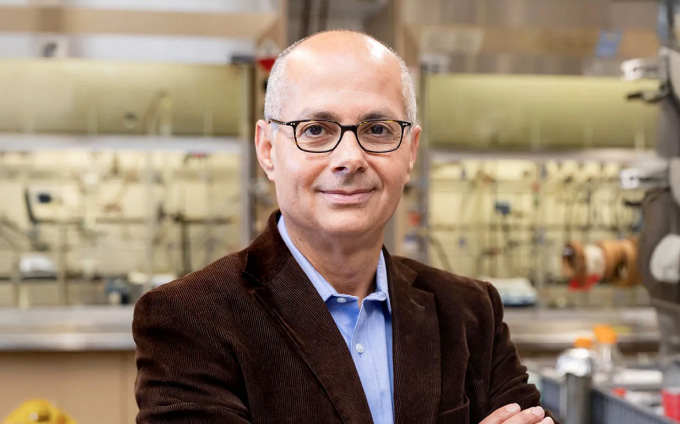
Professor Omar M. YAGHI
University Professor
James and Neeltje Tretter Chair Professor of Chemistry
Professor of Materials Science and Engineering
University of California, Berkeley
Nobel Laureate in Chemistry(2025)
University of California, Berkeley
Omar M. Yaghi, born on 9 February, 1965, in Amman, Jordan, is an American chemist renowned for his pioneering work in reticular chemistry, a discipline focused on creating materials in large frameworks composed of many molecules. In recognition of his significant contributions, he was awarded the 2025 Nobel Prize in Chemistry for the development of metal-organic frameworks (MOFs). Growing up in Amman, Yaghi moved to the United States at the age of 15 to further his education. He earned his bachelor's degree in chemistry from the State University of New York at Albany (now University at Albany) in 1985, followed by a PhD in chemistry from the University of Illinois at Urbana-Champaign in 1990. He completed his postdoctoral fellowship at Harvard University from 1990 to 1992.
Yaghi began his academic career as an assistant professor at Arizona State University in 1992. He became a professor at the University of Michigan in 1999 and later joined the University of California at Los Angeles (UCLA) in 2006. Since 2012, he has been a professor of chemistry at the University of California at Berkeley, where he also serves as the founding director of the Berkeley Global Science Institute. Established in 2014, the institute aims to mentor scientists globally and promote a closely-knit international scientific community.
In 1995, Yaghi and his collaborators developed the first metal-organic framework, utilizing metal atoms (such as cobalt) as nodes within the framework, interconnected by organic molecules. These porous materials feature built-in cavities that can capture specific substances by varying the building blocks. Following the pioneering work of Richard Robson around the turn of the millennium, Yaghi and Susumu Kitagawa advanced the development of flexible and stable MOFs. These materials have applications in harvesting water from desert air, capturing carbon dioxide, storing toxic gases, and catalyzing chemical reactions.
In 2005, Yaghi extended the field of reticular chemistry through the creation of covalent organic frameworks (COFs). These frameworks are formed by connecting light elements like boron, carbon, and oxygen through covalent bonds, yielding materials with large surface areas and customizable properties.
In 2020, Yaghi founded Atoco, a company dedicated to using MOFs for capturing carbon dioxide to combat climate change and extracting water from the air to enhance access to drinking water. Having grown up in a water-scarce environment, where drinking water was available only a few hours a week, he is particularly passionate about addressing this issue. In 2022, Yaghi and his team tested an MOF in Death Valley, California, discovering that 1 kg (2.2 pounds) of the MOF could yield 114–210 grams (4–7.4 ounces) of water per day from arid air.
Yaghi is also the co-author of Introduction to Reticular Chemistry: Metal-Organic Frameworks and Covalent Organic Frameworks (2019, with Markus J. Kalmutzki and Christian S. Diercks). His accolades include the Centenary Prize from the Royal Society of Chemistry (2010) and the Wolf Prize in Chemistry (2018, shared with Fujita Makoto).